Make packaging and labels easier to read: for producers and retailers
Updated 18 October 2026
Kemipilot is an app for staff at recycling sites and industrial locations. You photograph a chemical product, and the app says which drum it goes in. The app is also used for automatic scanning in industrial plants, for example at a conveyor belt, where cameras take the pictures by themselves as the products pass, and the packaging is only briefly in front of the camera. The app reads the label with the camera and looks the product up in our catalogue. The easier your packaging and data are to read by machine, the more often staff get the right answer the first time, and the less often your product ends up in the wrong drum.
Everything below is a wish, not a requirement. Most of it costs nothing if it is thought of the next time a label or a product page has to be redone anyway.
The most important things at a glance
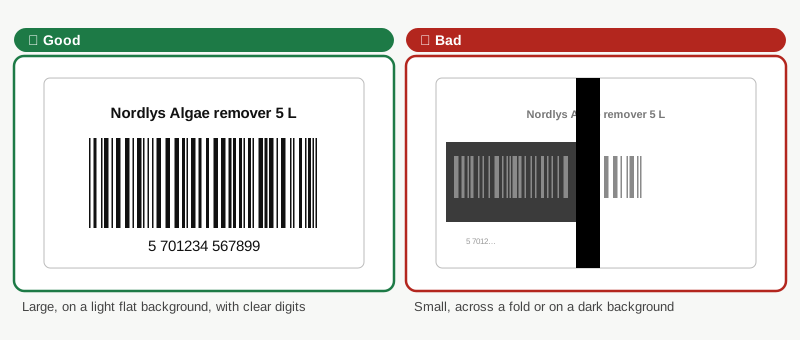
- The barcode (EAN) is clear and full size on a light, flat surface, and the same EAN is on your product page.
- A fixed link to the safety data sheet per product, with no login, no CAPTCHA and no form.
- The data sheet as a PDF with real text, not a scanned image, and preferably in Danish.
- The hazard labelling together on one flat side: pictograms and H statements (code and text) side by side, with high contrast.
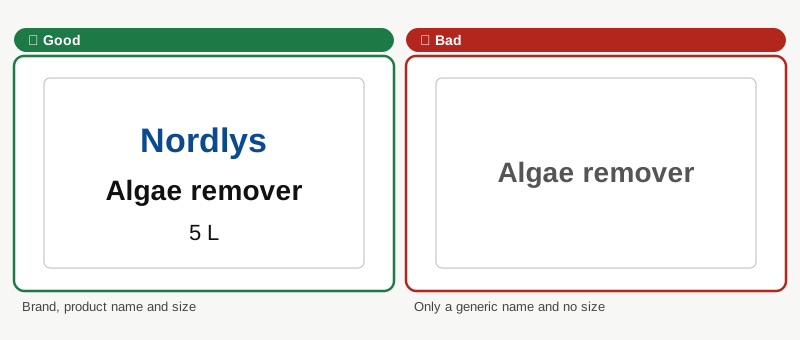
- The product name with brand and size, and the same name on the packaging, the product page and the data sheet.
- A CAS number for every ingredient, together in one block headed "Contains:".
Why it matters
We have measured it on our own figures:
- On flat label files with real text we read about nine out of ten H codes correctly.
- On a photo of a real bottle or drum, classic text recognition is usable on only about one photo in four to one in three.
- Only about 2 % of the labels we have read in the field mention an H code that can be read in the picture.
- A registration number for pesticides and biocides is read on under 1 % of all the labels we read.
- Only about 5 % of the labels we have read in the field show a CAS number, and 92 % of the CAS-like numbers we read have a valid check digit.
Small type is hardest: in research, text under about 7 point is only rarely recognised, and curved, glossy surfaces are also difficult.
Make it easy to see which product it is
The drawings on this page are schematic examples, not real products.
-
Print the EAN full size on a light, smooth surface, not in a fold or across a seam.
-
Give the product a full name: brand, product name and size. A generic name such as "Algae remover" alone can belong to many products.
-
Use the same name on the packaging, on the product page and in the data sheet, and give each variant and size its own EAN.
-
Print the approval number (pesticides and biocides) and the UFI clearly. They are the most reliable key we have for finding the right product. The UFI generator is at ECHA.
Make the safety data sheet easy to find and read
-
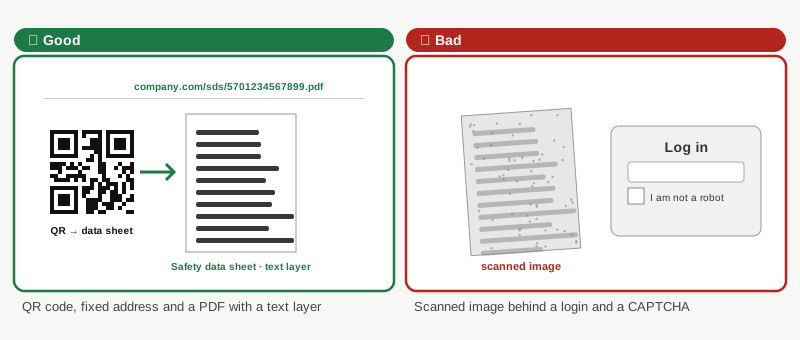
Use one fixed web address per product or variant. Data sheets behind a login, CAPTCHA, cookie wall or form cannot be used by us, and we do not get around them.
-
Put a QR code on the label that leads straight to the data sheet. A GS1 Digital Link lets the same code both open the data sheet and identify the product.
-
Make the data sheet a PDF with a text layer. A scanned image cannot be read reliably, and the H codes are in sections 2 and 3 of the data sheet.
-
State which EANs the data sheet applies to and put the version date on the front page, so we can see whether it is the latest.
-
If you have it, send us one combined file (CSV, JSON or XML) with the EAN, product name, data sheet link and H statements.
Make the ingredients easy to recognise
-
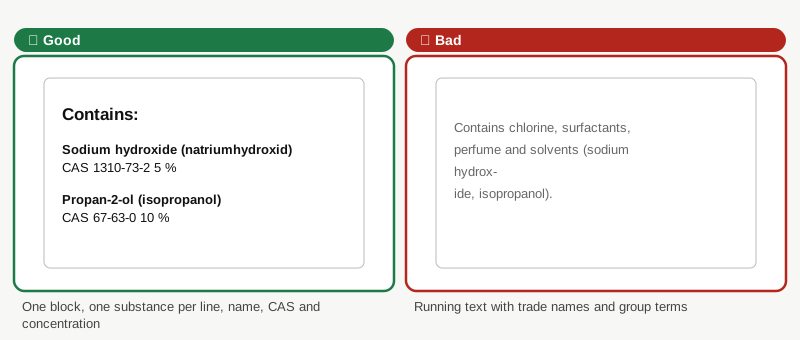
Print the CAS number for every ingredient, with the word "CAS" in front. It is a key, not a word, and the number has a check digit, so a misreading can be detected.
-
Print the name in both Danish and English if there is room. Danish helps the staff, and English is what our lookup knows most often.
-
Label other numbers clearly: the EC number with "EC" and the index number with "Index no.". Without a label an index number can look like a CAS number.
-
Print the concentration for the hazardous substances (for example "5 %"). Limit values decide which drum the product goes in.
-
Avoid a substance appearing only as a trade name or group term, for example "chlorine", "surfactants" or "perfume".
-
Put the substances in one block headed "Contains:", one substance per line, and do not let names or CAS numbers break across two lines.
-
A chemical formula (for example NaOH) may be added, but never instead of the CAS number or the name: the same formula can belong to several substances.
Make the hazard labelling easy to read in a photo
-
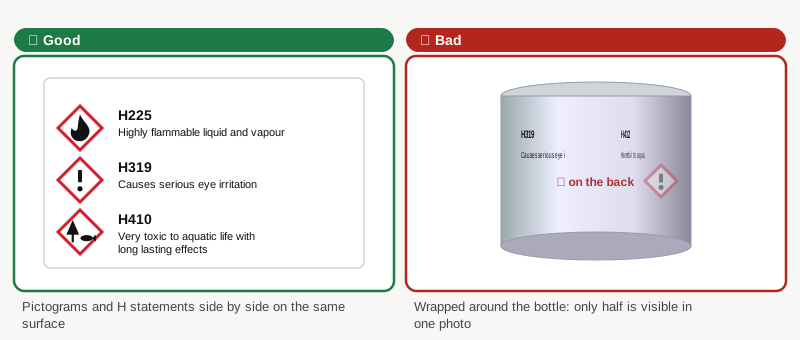
Put pictograms and H statements (both code and text, for example "H319 Causes serious eye irritation") on the same side, so one photo can show it all.
-
Keep the text flat and straight, not in the curve, in a seam fold or under glossy laminate or reflective material. A photo of a round bottle covers only half of it, so the hazard labelling should not wrap around.
-
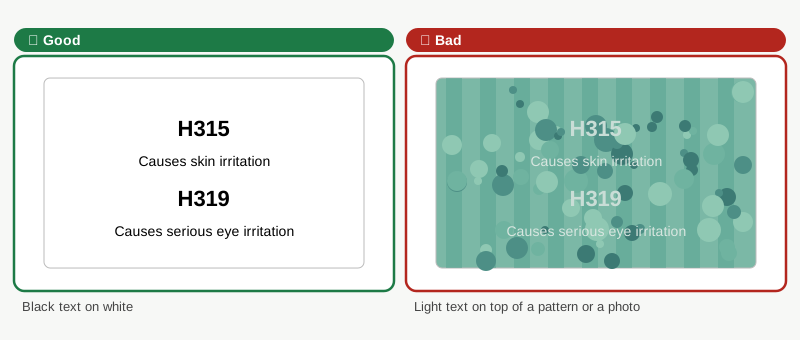
Use high contrast, preferably black text on a light background, and no text on top of a pattern or a photo.
-
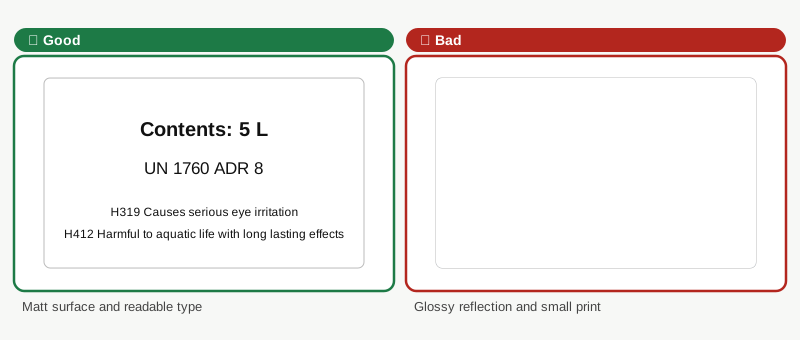
Follow at least the CLP minimum sizes, and prefer text that can be read from arm's length to the smallest permitted.
-
Print the contents (for example "5 L") clearly. If the product is classified for transport, print the UN number and the ADR class on the packaging.
What the law says
These are the rules that matter most for how labels can be read. It is an extract and not legal advice: always check the regulations themselves and the dates in force with ECHA or the Danish EPA.
- Hazard labelling (CLP, Regulation 1272/2008, Article 31): The label must be firmly affixed to the packaging and readable horizontally when the package is set down normally. The labelling must be clear and indelible, stand out clearly from the background and be of such size and spacing as to be easily read.
- Language (Article 17): The label must be in the official language of the country where the product is sold, unless the country decides otherwise. More languages are allowed if the details are the same in all of them.
- Ingredients (Article 18): For a mixture, the product identifier must, besides the trade name, name the substances that contribute to the classification, for example acute toxicity, corrosion, cancer and allergy.
- Dimensions (Annex I, section 1.2.1): The label must "if possible" be at least 52 × 74 mm on packages up to 3 L and 74 × 105 mm up to 50 L. Each pictogram must be at least 10 × 10 mm, preferably 16 × 16, up to 3 L, and at least 23 × 23 mm up to 50 L.
- Type size (new, Regulation 2024/2865): The type x-height must be at least 1.2 mm up to 0.5 L, 1.4 mm up to 3 L and 1.8 mm up to 50 L. The new label format rules have been postponed to 1 January 2028; until then the old minimum sizes apply.
- Digital labelling: CLP allows a QR code or another data carrier to lead to a digital label as a supplement. It does not replace the physical label.
- The packaging itself (Article 35): A mixture for the general public must not have a shape or design that arouses children's curiosity or resembles food, feed, medicine or cosmetics. Where Annex II requires it, it must have a child-resistant fastening and a tactile warning of danger.
- Detergents (Regulation 648/2004, Annex VII): Consumer products must state the content in ranges (under 5 %, 5-15 %, 15-30 % and 30 % and over) for, among others, phosphates, surfactants and bleaching agents, and always for perfumes, enzymes and disinfectants. Allergenic fragrances above 0.01 % must be named. Changes are on their way, so check whether the rules have been replaced.
- Plant protection products (Regulation 1107/2009, Article 65): The labelling must follow CLP and supplementary standard phrases.
- Packaging waste (PPWR, Regulation 2025/40, Article 12): From 12 August 2028 (or 24 months after the implementing rules, if later) packaging must carry a harmonised label on its material composition. Packaging with substances of concern must be marked digitally by standardised, open methods. Reusable packaging must from 12 February 2029 (or 30 months after the implementing rules, if later) bear a label saying it is reusable, with further information through a QR code or another open digital data carrier. Otherwise a QR code may be added voluntarily.
The rules are a minimum. Our wishes above go a little further, for example the CAS number and a fixed link to the data sheet.
For retailers
- Have one link to the data sheet per EAN on the product page, not only per category or brand, and keep the address stable.
- Tell us when a data sheet changes, or send one combined list with EAN, name and data sheet link.
- We only fetch from open pages and at a low rate, and we leave pages behind a CAPTCHA or login alone. If you prefer that we get a file or a particular address, write to us.
What we do with it
- Hazard statements are always shown with their source, and we never call a product harmless because data is missing.
- Only data from the product's own data sheet (or an authority's classification, such as the Danish EPA's for pesticides) is written as the product's hazard data.
- We use your data to sort correctly.
Questions
Write to kontakt@kemipilot.com.